
FG pushes Nigeria Industrial Policy 2025 to reset how industrialisation shapes national economic strategy
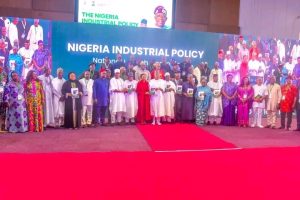
Vice President Kashim Shettima and other dignitaries in group photo during the launch of Nigeria Industrial Policy 2025 (NIP 2025) in Abuja.
The Federal Government has risen to the occasion with the introduction of the Nigeria Industrial Policy 2025 (NIP 2025) to reset how industrialisation shapes national economic strategy. Launched on 17 February 2026 at the Bola Ahmed Tinubu International Conference Centre, Vice President Kashim Shettima unveiled the framework on behalf of President Bola Ahmed Tinubu GCFR. With this policy, manufacturing is now being reframed as a tool of national resilience and economic security, and growth will increasingly be measured by the quantity and quality of factories built, exports expanded, and jobs created — not oil revenue alone, as was the case in the past, write Editor Gentechnews, Tony Nwakaegho
The Federal Government newly unveiled Nigeria industrial policy 2025(NIP 2025) represents a deliberate attempt to reset the country’s economic philosophy. For decades, Nigeria’s economy has oscillated between resource dependence and fragmented industrial ambition. The newly launched policy marks a conscious shift toward production-led growth, institutional coordination, and industrial competitiveness as the foundation of national prosperity.
The policy envisions a paradigm shift from policy to performance as it acknowledges a long-standing truth that countries do not industrialise accidentally, but deliberately. With targets such as increasing manufacturing’s contribution to GDP toward 25 per cent, reviving dormant factories, expanding exports, and generating large-scale employment, the government is positioning industrialisation as a macroeconomic strategy rather than a narrow sectoral intervention.
In this respect, Nigeria appears to be drawing lessons from development trajectories similar to those of South Korea and Singapore, where industrial capacity preceded sustained prosperity.
The most consequential signal within the policy is the commitment to allocate up to five per cent of GDP to industrial financing and for corporate leaders, this materially changes the investment calculus.
It is trite to state that industrial policy without finance is just paper promises; finance without direction fuels speculation, hence by attempting to combine both, the framework could reduce the cost of capital for manufacturers, enable scale investments, and unlock the long-tenor financing historically absent in Nigeria’s industrial landscape.
In executive terms, this marks the difference between survival and expansion manufacturing.
The government, with expanded targeted measures aimed at lowering structural trade costs and accelerating export competitiveness, appears to recognise that Nigeria’s industrial challenge is less about entrepreneurial deficiency and more about systemic friction.
However, business leaders are acutely familiar with these frictions which include, logistics inefficiencies, energy instability, port congestion, regulatory overlap, and policy unpredictability.
Accordingly, the policy’s shift from subsidy-heavy approaches toward competitiveness infrastructure reflects a more sustainable and disciplined industrial strategy.
The policy also harps on agro-processing, renewable energy, mining expansion, and manufacturing clusters which signals a move toward value-chain industrialisation rather than isolated factory development.
Although modern industrial success depends on ecosystems — upstream inputs, midstream processing, and downstream market access, but for manufacturing CEOs, competitive advantage will increasingly hinge on integration partnerships, supplier development, and regional market positioning, particularly under the framework of the African Continental Free Trade Area (AfCFTA), which expands the horizon beyond domestic demand alone.
Industry captains also acknowledged that history repeatedly demonstrates, policy design is rarely Nigeria’s core problem, because there is no execution discipline, hence strong frameworks have previously been weakened by institutional fragmentation, regulatory duplication, weak monitoring mechanisms, and abrupt policy reversals.
It is apt that the industrial policy implicitly recognises this risk by emphasising coordination across ministries and structured collaboration with industry.
Business leaders have welcomed this shift in posture as industry must become a co-executor rather than a passive beneficiary.
Nevertheless, global evidence suggests industrial policy succeeds only when it avoids two persistent traps: protection without productivity and finance without performance accountability.
Nigeria has historically leaned toward protectionist impulses that sometimes raised production costs and constrained export competitiveness. Therefore, if implementation drifts toward rent-seeking rather than measurable productivity gains, the policy risks becoming another expensive cycle rather than a structural transformation.
Beyond economics, NIP2025 represents a structural rebalancing of responsibility between government and industry, with the government signalling that production — not consumption, not import arbitrage — must become the engine of growth.
In return, manufacturers are expected to scale capacity, deepen local value addition, formalise supply chains, and generate measurable employment. This rebalancing shifts the expectations on both sides. Government support will be justified by performance, and industrial incentives will likely be tied to measurable outcomes — output expansion, local sourcing ratios, export growth, and employment intensity. The operating model moves from surviving policy cycles to competing within a production-centred growth framework where scale, efficiency, and value addition determine long-term advantage.
The Director-General of the Manufacturers Association of Nigeria (MAN), Segun Ajayi-Kadir, mni, in a recent position statement highlighted that the success of the newly-launched National Industrial Policy (NIP) will be tested by the chronically unstable power sector as well as implementation.
He said energy reform is the single most critical variable in determining whether the government’s target of raising manufacturing’s contribution to the gross domestic product (GDP) to 25 per cent by 2035 would be achieved or become another abandoned industrial aspiration.
The policy, which he described as the most inclusive industrial blueprint Nigeria has produced in over six decades, sets out to lift manufacturing’s GDP contribution from its current nine to 11 per cent, raise sector capacity utilisation from 50 to 75 per cent and position the country as a competitive manufacturing hub under the African Continental Free Trade Area (AfCFTA).
Ajayi-Kadir, however, noted that none of these targets was reachable without a fundamental resolution of the power question.
Ajayi-Kadir, urged the Central Bank of Nigeria (CBN) beyond energy issue, to further lower interest rates, arguing that high borrowing costs are compounding the burden already imposed by unreliable power supply
“With inflation and naira stabilising, there should be room to reduce interest rates and ease the cost of borrowing for manufacturers,” he said.
Ajayi-Kadir also called on state governments to develop complementary industrial policies, noting that with at least 37 budgets deployed annually across federal and state levels, all tiers of government must treat industrialisation as a deliberate strategic priority.
In all these, the real test now begins as to whether this framework can deliver measurable industrial outcomes and set a benchmark for Africa’s emerging industrial strategies.
Pan-African Manufacturers Association (PAMA) which serves as the continental voice of manufacturers, posited that this policy is less a surprise and more a long-awaited response to years of advocacy by manufacturers and other key industrial stakeholders for a clear, coordinated, and well-funded industrial strategy.
PAMA emphasized that the proposed financing allocation should be operationalised through a structured industrial funding mechanism with clear eligibility standards, sector prioritisation criteria, and performance-based monitoring.
According to PAMA, export expansion targets should be underpinned by coordinated trade facilitation, logistics reform, and competitiveness support, while cluster development should prioritise integrated production ecosystems over isolated estates.
Trade-cost reduction commitments, it noted should translate into measurable efficiency gains at ports, borders, and transport corridors.
It averred that effective implementation of these measures would institutionalise predictability and reduce discretionary intervention in industrial governance.
“At the continental level, the policy provides a governance reference point, particularly for African countries that either operate without a coherent industrial policy or rely on fragmented sectoral initiatives.
“NIP 2025 demonstrates that industrialisation requires three foundational components: quantified targets, financing alignment, and institutional coordination. Without these, industrial ambition remains unfulfilled.
“For countries without a formal industrial framework, the lesson is not to replicate Nigeria’s model mechanically, but to recognise that industrial development cannot be outsourced to market forces alone. Clear production priorities, value-chain mapping, export strategy alignment, and structured public–private coordination are prerequisites for scale manufacturing. Absent this, economies risk remaining consumption-driven, commodity-dependent, or transit markets for imported goods.
“For countries that already have industrial strategies, the implication is different. The success or effectiveness of these policies will be measured by their ability to integrate into continental value chains under the African Continental Free Trade Area. Industrial policies that are inward-looking or purely protective may struggle in a more liberalised African market environment. Those that prioritise productivity, specialisation, and cross-border production networks will be better positioned.
“In this context, NIP 2025 situates Nigeria within a broader continental transition toward structured, performance-based industrial governance. Its long-term significance will depend on disciplined execution and its capacity to integrate national production systems into Africa’s evolving industrial architecture,” PAMA concluded.