
NCC, States to collaborate on Policies on RoW, CNII, to Boost Broadband Investment
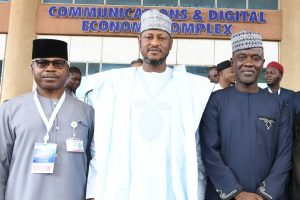
The Executive Vice Chairman of the Nigerian Communications Commission (NCC), Dr. Aminu Maida, has called for robust collaboration between the Federal Government and state governments to accelerate broadband deployment, reduce Right of Way (RoW) bottlenecks, and safeguard Nigeria’s critical telecom infrastructure.
Dr. Maida made the call while speaking at the Business Roundtable Forum with States themed “Right of Way and Protection of Broadband Infrastructure – The Road to Success in Broadband Investment and Connectivity”, held at the NCC Digital Economy Complex, Abuja, adding that the country’s digital prosperity depends on aligning policies across all levels of government to foster investment, connectivity, and inclusion.
“In earlier eras, a community without a railway or electricity could still subsist. In today’s world, a community without digital connectivity is invisible,” he said. “It is cut off from education, markets, healthcare, and opportunity. We must act decisively, state by state, community by community, to ensure no one is left behind.”
The event brought together governors’ representatives, policymakers, and industry stakeholders to discuss practical ways to harmonize policies that will enable broadband growth nationwide.
Why Connectivity Matters
Dr. Maida highlighted that when we talk about connectivity, our minds go to faster downloads or smoother video calls far, adding connectivity today equals economic inclusion, productivity, and national resilience.
“As of August 2025, Nigeria had achieved a broadband penetration rate of roughly 48.81% with over 140 million people having internet access. The ICT/telecom sector is already one of the leading contributors to Nigeria’s GDP. Research shows that a 10% increase in broadband penetration can drive approximately 1.38% GDP growth in developing economies so imagine what a 20%, 30%, 40% increase in broadband penetration would do: (there would be more billions in economic output, new jobs, new services, and innovation hubs across our states),” he said.
He cited Nigeria’s digital prospective to the success stories in Rwanda and India, where investments in broadband and digital governance have driven economic expansion, as Rwanda has positioned itself as an African hub of digital services by investing heavily in backbone fibre and digital governance, while India’s outsourcing and IT services industry is worth hundreds of billions of dollars (worth over $240 billion annually), enabled largely by early and consistent investment in digital infrastructure and human capacity.
“With over 200 million people and a median age of 18, Nigeria can not only follow those trajectories but surpass them, if we equip our youth with reliable, affordable, high-speed connectivity,” EVC said.
Progress and Challenges
Under the Tinubu administration and the leadership of Dr. Bosun Tijani, the minister of Communications, Innovation and Digital Economy, NCC has implemented several strategic interventions to reinforce the telecommunications ecosystem, as Nigeria is pursuing the ambitious targets of the National Broadband Plan (2020–2025) with plan set to achieve 70% broadband penetration by the end of 2025 and to deploy 90,000 kilometres of fibre optic backbone infrastructure across the country.
Dr. Maida stated that through continuous advocacy, the Critical National Information Infrastructure (CNII) Presidential Order was signed in June 2024, providing legal backing for the protection of telecom assets, adding that the Commission is working closely with the Office of the National Security Adviser that has been tasked with ensuring the full operationalisation of this mandate in the telecommunications sector, while the Commission has set up a Telecommunications Industry Working Group to coordinate its operationalisation.
He explained that the Commission has also launched a broad public awareness drive, including TV and radio jingles, social media campaigns, and community engagement initiatives, to mobilise citizens in protecting telecom infrastructure, adding that prosecutions have already led to the dismantling of major cartels behind telecom equipment theft across the country.
According to him, one of the most significant barriers to broadband deployment in Nigeria has been the high cost of Right of Way (RoW) fees charged by state governments, despite a resolution by the Nigerian Governors Forum fixing the rate at N145 per linear meter.
He revealed that the Commission intensified advocacy with states to reduce or waive these fees to accelerate broadband rollout and within the past two years, five additional states—Adamawa, Bauchi, Enugu, Benue, and Zamfara—have waived RoW fees entirely, thereby bringing the total number of states offering zero RoW charges to eleven (11), while 17 states have capped it at N145 per metre.
He affirmed that they are also promoting the “dig-once” coordination with public works to cut avoidable fibre damage and lower civil-works costs by sharing ducts and plans, stressing that the goal is to achieve a uniform, predictable RoW countrywide, paired with clear permitting SLAs.
He lamented that despite these significant efforts, some challenges remain, adding that infrastructure attacks and vandalism continue to pose a challenge, as between January and August 2025 alone, Nigeria recorded 19,384 fibre cut incidents, 3,241 cases of equipment theft, and over 19,000 cases of denials of access to telecom sites.
“Together, these disruptions have caused prolonged outages, revenue losses, increased security costs, and delayed service restoration. They demonstrate why infrastructure protection must be at the centre of our collective agenda.
“I can confirm to you that operators have made collective commitment to investing over $1 billion in additional rollout investments to expand broadband coverage and capacity nationwide. We will keep monitoring quality, so consumers see the benefit in better service,” he said.
He pointed out the urgency in this trend because the global digital race is accelerating as Artificial Intelligence is transforming industries; outsourcing is shifting to low-cost, high-connectivity environments.
He warned that if our broadband backbone is weak, our youth will be marginalized, and our economy will likely not achieve its full potential, adding “We must act decisively—state by state, community by community—to ensure no one is left behind.”
He stated further that in states that have waived RoW and supported infrastructure protection, operators are expanding networks with greater confidence, adding that “we need alignment across all 36 states and the Federal Capital Territory. If every state embraces uniform, pro-investment policies, we can transform Nigeria into a continental digital powerhouse.”
Dr. Maida made some concrete requests to the States thus: “Be a partner in the operationalisation and enforcement of telecom assets as critical infrastructure.
“Adopt 100% RoW waiver statewide (or at minimum the NGF benchmark), with clear SLA timelines for approvals.
“Institutionalise coordination between road/public works and operators—shared planning portals, advance works notifications, and dig-once protocols to prevent accidental cuts.
“Embrace transparency: Publish standard processes, timelines, and fees; adopt single- window permitting where possible.
“Create state digital-infra funds/incentives to crowd in private fibre in rural or underserved areas; leverage PPPs for open-access backbone and metro builds.
“Facilitate energy resilience: Support hybrid/solar power at sites to improve uptime and reduce OPEX and emissions.”
About the Roundtable
The Business Roundtable Forum was organized by the Nigerian Communications Commission (NCC) to foster dialogue between federal and states on improving investments in broadband connectivity and safeguarding critical national infrastructure.
The Nigerian Communications Commission has assured that it will continue to protect and expand Nigeria’s connectivity, noting that together, with Governors and States, operators, the private sector, security agencies, and development partners, they can ensure that our youth become creators, not merely consumers of digital value.
“The digital revolution does not wait. Let us align, invest, and protect, for the prosperity of our people and the future of our nation,” the EVC emphasized.