
Ogbonna Charts Vision for Banking in Global Africa at Bloomberg Summit
By Olusegun Obisanya
Managing Director/CEO of Access Bank, Roosevelt Ogbonna, has outlined an ambitious roadmap for the future of African banking, urging financial leaders across the continent to embrace a model that positions Africa as a globally integrated economic powerhouse.
He shared this vision at the Bloomberg Africa Business Summit, where top banking executives and international investors gathered to discuss how Africa can sustainably fund its growth in a rapidly shifting global landscape.
In a statement from the financial institution, the CEO addressed an audience of policymakers, global capital managers and private-sector leaders.
He reaffirmed the underlying strength and resilience of African markets, despite geopolitical uncertainties and structural challenges.
Citing Nigeria’s recent Eurobond issuance—which was oversubscribed multiple times—he said the development was evidence that global investors remain responsive to reform-led African economies.
“Markets are more intelligent than the narratives that often surround Africa,” he said, stressing that sustained policy reforms, transparency and disciplined governance continue to send strong signals to international capital pools.
These conditions, he noted, are helping to lay a firmer foundation for the continent’s next phase of economic acceleration.
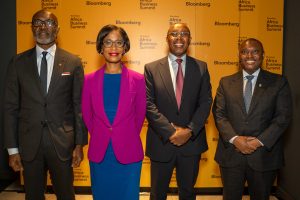
Speaking alongside Sim Tshabalala, CEO of Standard Bank Group, and Kenny Fihla, Group CEO of Absa Group, Ogbonna projected a future in which Africa is not merely a destination for consumption, but a nucleus for global trade, innovation and production. With a wealth of natural resources, a rapidly growing talent pool and expanding technological infrastructure, he argued that the continent is fully equipped to ascend the value chain—transitioning from raw commodity exports to manufacturing and delivering value-added products at scale.
He explained that Access Bank is already aligning itself with this shift through its commitment to “full-spectrum banking,” which supports retail consumers, small and medium enterprises, large corporates and investment-driven sectors including renewable energy, digital infrastructure and industrial processing.
This integrated approach, he said, is designed to energise every layer of economic activity.
The financial expert also highlighted a strategic opening for African banks as many Western institutions scale down their operations across the continent. Access Bank’s expanding pan-African footprint, he noted, reflects a Global Africa strategy anchored in deep local expertise and an ability to design market-specific solutions that foreign players often overlook.
“The objective goes beyond profitability. It is about catalysing growth, strengthening ecosystems and driving development across regions and sectors,” Ogbonna added.
He emphasised that the future of African banking will depend on leaders who can combine global perspective with strong local ownership. This includes engaging international capital markets while deliberately investing in Africa’s infrastructure, talent and homegrown enterprises. A crucial part of this effort, he added, is dismantling the “perception premium”—a persistent risk bias that raises the cost of capital for African businesses and governments.
Ogbonna expressed confidence that Africa has all the ingredients needed to finance its own development: vast resources, dynamic talent and an emerging generation of innovators.
What remains, he said, is visionary leadership to align these strengths with a unified, globally relevant African ambition.
The Bloomberg Africa Business Summit underscored this call to action, reinforcing the view that Africa’s financial destiny will be shaped not by external forces, but by Africans prepared to lead, invest and build a future rooted in the ideals of a “Global Africa.”