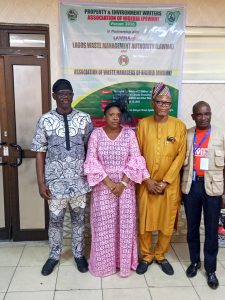
Stakeholders at PEWAN Forum Brainstorm on Challenges of Managing Waste Generated by Over 22 Million Lagos Residents
The challenge of managing the waste generated by over 22 million residents was scrutinized on Wednesday by stakeholders when they converged at the 2026 quarterly forum of the Property and Environment Writers Association of Nigeria (PEWAN), with a clarion call for a transition from a linear disposal model to a circular economy.
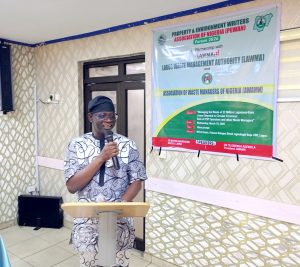
Delivering the keynote address, the Managing Director/Chief Executive Officer of the Lagos Waste Management Authority, Dr. Muyiwa Gbadegesin, said waste management in Lagos must be seen beyond routine evacuation, describing it as a critical test of governance in one of Africa’s largest megacities.
Gbadegesin who was represented by Kunle Adebiyi, Executive Director Lagos State Waste Management Authority (LAWMA) highlighted that the implications of ineffective waste management extend far beyond sanitation, cutting across public health, urban planning, flooding, real estate value, and investor confidence. According to him, a failure in waste management systems inevitably triggers wider urban disorder.
“For a long time, cities operated a linear model where waste is generated, collected, and dumped. That approach is no longer sustainable for a city of Lagos’ size, density, and ecological vulnerability,” he said.
He explained that the emerging focus must be on a circular system, where waste is treated as a resource stream to be reduced, sorted, processed, and reintegrated into productive use, rather than simply disposed of.
The LAWMA boss explained that Lagos’ unique coastal and amphibious geography makes the issue even more urgent, as improperly managed waste often finds its way into drainage channels, exacerbating flooding and marine pollution.
“In Lagos, waste does not stay where it is dropped. It travels through drains, canals, lagoons and creeks, eventually becoming a broader environmental and public health problem,” he added.
Tracing the evolution of Private Sector Participation (PSP) in waste management, Gbadegesin recalled that the model began in 1997, expanded in 1999, and underwent restructuring in 2004 and 2007 when oversight was transferred to LAWMA. Today, Lagos has about 450 PSP operators serving as the primary interface between the formal waste system and residents.
He stated that while PSP operators remain indispensable, their roles must evolve in line with modern waste management demands, adding “The PSP operator of the future cannot be judged only by tonnage evacuated, but by service quality, responsiveness, data management, and contribution to reducing landfill dependence,”
According to him, professionalism, improved route planning, better fleet management, and enhanced customer engagement are critical to strengthening the PSP framework.
However, he cautioned that PSP operators alone cannot drive the transition to a circular economy, stressing the need for a broader ecosystem involving recyclers, aggregators, processors, and specialised waste handlers.
He emphasised the importance of developing downstream markets for recyclables such as plastics, metals, paper, and glass, noting that collection without recovery merely shifts the problem rather than solving it.
Gbadegesin also harped on the need to treat different waste streams distinctly, including medical, electronic, construction, and hazardous waste, each requiring specialised handling systems.
Speaking on organic waste, he pointed out that a significant portion of urban waste streams consists of biodegradable materials, which, if properly harnessed, could reduce landfill pressure and methane emissions while creating opportunities for composting.
A major highlight of his presentation was the call to integrate the informal sector into the formal waste management system through structured and professionalised frameworks.
He proposed the deployment of trained last-mile collectors using cargo bicycles to recover recyclable materials directly from households and businesses before contamination occurs.
“This model is cheaper, more agile, and can penetrate areas inaccessible to trucks. It also improves material quality and creates jobs at the community level,” he asserted.
Gbadegesin, however, warned against romanticising informality, stressing that integration must involve proper training, registration, supervision, and linkage to formal recycling markets.
He outlined a tiered system where PSP operators handle residual waste, organised micro-collectors manage recyclables at source, and aggregators and processors convert recovered materials into usable products.
Such integration, he said, would reduce pressure on landfills, improve recycling efficiency, and gradually change public behaviour toward waste.
He also underscored the importance of citizen participation, noting that no waste system can succeed without active involvement from residents, businesses, and institutions.
“Source separation does not happen by decree. It requires awareness, trust, convenience, and enforcement,” he said.
Earlier in her welcome address, the Chairman of PEWAN, Mrs. Okwy Iroegbu-Chikezie, said the forum was convened as part of the association’s advocacy efforts to address persistent waste management challenges in Lagos.
She commended the Lagos State Government and LAWMA for ongoing reforms, including the implementation of a 10-year technology-driven waste management plan under the THEMES+ agenda, the transition to Material Recovery Facilities, and the upgrade of Transfer Loading Stations at Olusosun and Solous.
She also highlighted initiatives such as the “Trash for Cash” programme and plans to deploy 100 Compressed Natural Gas-powered compactor trucks, alongside the introduction of smart bins.
Despite these efforts, she noted that significant challenges remain, including rapid urbanisation, limited waste collection coverage, and low recycling rates.
“With over 13,000 tonnes of waste generated daily and only about 40 per cent effectively collected, much still needs to be done,” she said.
She called for increased investment in waste infrastructure, improved policy enforcement, enhanced public awareness on waste segregation, and stronger collaboration between government, private sector, and communities.
The PEWAN chairman stressed that sustainable waste management is central to achieving a livable and environmentally friendly Lagos, urging stakeholders to adopt innovative and practical solutions.
Participants at the forum agreed that Lagos stands at a critical juncture, where the shift from a disposal-driven system to a resource-driven circular economy is no longer optional but imperative.
As discussions progressed, the stakeholders were unanimous that managing the waste of millions of Lagosians is not merely about collection and disposal, but about building a resilient system that transforms waste into value, creates jobs, and enhances urban sustainability.
For stakeholders, the message was clear: the future of Lagos depends not just on how waste is removed, but on how it is reimagined.
PHOTO NEWS