
The Road To A $1 Trillion Economy By 2030: Beyond Reform

This edition of BACITI Economic Insight reviews highlights from the NIIA Trade and Investment Forum, where financial experts academics, and practitioners offered strategic guidance for Nigeria’s journey toward a $1 trillion economy.
GDP Trend: Nigeria Among Africa’s Top Six Economies
Between 2019 and 2025, Nigeria, Egypt, South Africa, Algeria, Morocco, and Ethiopia have all experienced fluctuations driven by global and domestic dynamics. Nigeria’s GDP trajectory stands out, marked by a sharp decline in 2024 followed by a modest rebound in 2025. From $668 billion in 2019, Nigeria’s GDP fell to $252 billion in 2024, recovering slightly to $285 billion in 2025. This dollar-denominated contraction resulted largely from exchange rate unification, naira depreciation, subsidy removal, and inflationary pressures following fiscal reforms. Though painful, these adjustments represent structural corrections aimed at long-term resilience. With its vast market, young population, and reform momentum, Nigeria remains central to Africa’s economic future and well-positioned for a stronger rebound once macroeconomic stability takes firmer root.
Reform vs. Transformation
Reforms stabilize; transformation industrializes. Nigeria’s recent macroeconomic reforms have improved fiscal liquidity and reduced structural distortions. However, they have yet to unlock productivity growth. In 2024, real GDP grew by 3.4%, outpacing the 2.1% population growth rate. Yet inflation averaged 26%, significantly eroding household welfare.
Scholars like Dani Rodrik (2004) and Justin Lin (2012) remind us that true structural transformation requires more than macro-stability, it depends on productive investment, technology absorption, and institutional coherence. Nigeria’s fiscal reforms have expanded government revenues, but manufacturing output has stagnated.
Services dominate GDP composition, while industrial growth remains weak, highlighting an imbalance reform alone cannot resolve.
The Trade Facilitation Paradox
Trade facilitation is a cornerstone of the current reform agenda. The Nigeria Customs Service (NCS) has launched the Unified Customs Management System (UCMS)—B’ODOGWU (Strong
Border), to replace NICIS with a homegrown digital clearance system. While this has improved transparency and revenue efficiency, significant logistics bottlenecks persist.
The World Bank reports that clearing goods in Nigerian ports takes an average of 19 days, compared to 7 days in Ghana and 5 in Morocco. Port congestion, fragmented inter-agency coordination, and inadequate infrastructure continue to undermine digitization gains. While commendable progress has been made, more systemic reforms are needed to align trade facilitation with Nigeria’s trillion-dollar goal
Investment Flows and the Confidence Deficit
Foreign direct investment (FDI) inflows declined from $3.31 billion in 2021 to $1.08 billion in 2024 (UNCTAD, 2024). In contrast, South Africa attracted $5.23 billion and Egypt $9.84 billion in the same period—out of Africa’s total of $52.63 billion.
The key deterrents are clear: policy uncertainty, weak infrastructure, and inefficient dispute resolution. As highlighted by Mrs. Etobere at the BACITI Forum, over 80% of impact investments in Nigeria originate from foreign development finance institutions (DFIs), while domestic investors account for less than 5%. This reflects not just a lack of capital—but a deficit of trust.
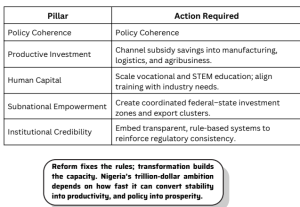
Rebuilding investor confidence requires more than fiscal incentives. Nigeria must institutionalize rule-based governance, adopt open investment dashboards, align with ISSB frameworks, and embed fiscal transparency. Institutional credibility—not improvisation—will be the true magnet for capital.
Subnational Competitiveness: The Geography of Growth
Nigeria’s growth potential is increasingly regional. States like Lagos, Ogun, Rivers, and Kano function as autonomous economic hubs. Lagos alone contributes nearly 30% of national GDP and over 70% of non-oil exports.
Subnational competitiveness matters: investors interact with locations, not just national governments. Lagos’s policy consistency, PPP-driven infrastructure, and trade-friendly institutions offer a blueprint for other states. As Mrs. Folashade Medebem (Commissioner, Lagos State Ministry of Commerce, Cooperatives, Trade and Investment) emphasized, federal ambitions must align with state-level ecosystems. Competitive federalism, where states specialize and attract investment independently, can transform Nigeria’s economic geography.
Structural Transformation: The Missing Link
Nigeria’s growth is stuck between policy reform and production inertia. The private sector struggles with multiple taxation layers, unreliable electricity (5,000 MW for 230 million people), and frequent policy reversals. As Prof. Olawale of the University of Ibadan argues, the missing link is policy coherence; the alignment of fiscal, monetary, and trade policies.
Customs reform is meaningless without efficient transport. Exchange rate unification achieves little without export capacity. Prof. Olawale estimates that achieving a $1 trillion economy will require sustained annual growth of 15–19%, attainable only through industrial deepening and value-chain integration.
Current export data confirms structural fragility: crude oil accounts for 62.9% of total exports; LNG 9.4%; raw materials 5.1%; manufactured goods 1.4%; and agriculture 8.3%. Nigeria remains dangerously dependent on primary commodities. Diversifying into high-value manufacturing and services is no longer optional—it is existential.
GDP Trend: Nigeria Among Africa’s Top Six Economies
From Reform to Productivity: A Policy Roadmap
To transition from reform to transformation, Nigeria must adopt a Productivity First framework based on five core pillars:
Conclusion
The Economics of Trust
Reform can fix the rules, but only trust can mobilize investment. A $1 trillion economy must be built, not declared. It requires factories, ports, rules, and results.
Nigeria must shift from reform as reaction to reform as architecture—ensuring that every macroeconomic adjustment leads to tangible productivity gains. The difference between a reforming and a transforming nation lies in coordination, credibility, and consistency.
In this sense, the road to a trillion-dollar economy is less about ambition and more about execution discipline. Reform is the headline; transformation is the fine print. Nigeria’s trillion-dollar ambition is achievable, but only if reform evolves into transformation –if the state moves from managing scarcity to enabling productivity.
As Bismark put it, “you can grow your revenue and still have unhappy people.” True growth is not fiscal; it is functional –the capacity of an economy to turn policy into prosperity.