
Agrofood Nigeria 2026 Highlights Nigeria’s €222bn Food Market Potential, Calls for Value Chain Transformation
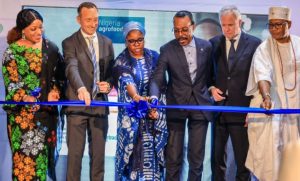
The 11th edition of agrofood Nigeria once again brings together companies, innovators, and decision-makers from Nigeria and around the world to chart pathway solutions to strengthen value chains, improve productivity, and support the continued development of Nigeria’s dynamic agrofood industries.
This year’s 11th edition being organised by fairtrade Messe, in conjunction with its local partner Modion Communications, cut across the exhibition sectors, including agro, food and beverage technology, food ingredients, packaging, and food & hospitality, with 137 exhibitors’ presence for the three-days event.
Speaking at the fairtrade Messe GmbH’s 2026 edition of the 11th anniversary of agrofood & plastprintpack Nigeria exhibition and conference in Lagos on Tuesday, eminent personalities, including, the Governor of Lagos State, Mr. Babajide Olusola Sanwo-Olu; represented by Commissioner for Agriculture and Food Systems, Lagos State, Ms Ruth Abiola Olusanya; First Lady, Akwa Ibom State, H.E Helen Eno-Obareki; Managing Director, fairtrade Messe, Paul Marz; Managing Director, Financial Derivatives Company Ltd, Bismarck Rewane; representative of the Oyo State Government, Chief Debo Akande; Ambassador, Kingdom of the Netherlands, H.E. Bengt van Loosdrecht; President, Manufacturers’ Association of Nigeria (MAN), Otunba Francis Meshioye, and the representative of Nigeria Association of Chambers of Commerce, Industry, Mines and Agriculture (NACCIMA), National President, Engr. (Dr.) Jani Ibrahim, mni, OON, emphasized that Nigeria is a key agro-allied nation with immense potential.
Talking about the theme of this year’s conference, “Achieving World-Class Food Security in Nigeria,” the key stakeholders explained that it is both timely and imperative, as it speaks directly to the structural realities of our economy and the urgent need to reposition agriculture not merely as a subsistence activity, but as a catalyst for industrial transformation, trade expansion, and inclusive economic growth.
They projected that the Nigerian food market is to reach around 222 billion EUR by 2026, with strong annual growth expected in the years ahead.
In his keynote address at the event, Lagos State Governor, Babajide Sanwo-Olu, represented by the Commissioner for Agriculture and Food Systems, Ruth Abiola Olusanya, described Lagos as Africa’s largest food consumption hub and a strategic entry point for investors seeking access to Nigeria’s vast agrofood market.
The Governor noted that Lagos’ food economy has grown significantly in recent years, rising from ₦6.5 trillion in 2019 to over ₦16 trillion, while the state contributes about 22 percent of Nigeria’s GDP and remains the most structured and accessible market for agro-processing, cold chain, and food technology investments on the continent.
According to him, the exhibition demonstrates the enormous opportunities available to global exhibitors and investors, particularly in processing, storage, logistics, and packaging, which are essential to building a resilient food system and strengthening Nigeria’s economic growth.
The Managing Director of Fairtrade Messe, Paul Marz, said the exhibition continues to serve as a bridge between global technology providers and Nigeria’s agrofood industry, enabling knowledge transfer, investment partnerships, and innovation-driven development.
The Managing Director, Financial Derivatives Company Ltd, Bismarck Rewane who spoke about the adverse effects of the Middle East conflict on Nigeria’s agric sector, warned that global economic uncertainties, including geopolitical tensions in the Middle East, could have ripple effects on Nigeria’s food prices and supply chains, urging stakeholders to strengthen domestic production and value addition to mitigate external shocks
The President of the Organization for Technology Advancement of Cold Chain in West Africa (OTACCWA), Mr. Alexander Isong, bemoaned cold chain as an industry that has seen very little penetration into the Nigerian economy and thereby has been unable to enjoy advantages which cold chain brings to it.
According to him, “But here is the honest truth: the real bottleneck is no longer on the farm. It is everything that happens after the harvest.
Isong said “Last year alone, Nigeria lost between ₦3.5 trillion and ₦5 trillion — that is 30 to 40 million metric tonnes of food — to post-harvest waste, mainly because of poor storage and broken logistics. On top of that, over 97 per cent of our agricultural exports still leave the country completely unprocessed.”
The President of OTACCWA harped on the urgent need to invest in cold chain infrastructure to reduce post-harvest losses and improve food security.
The President, Manufacturers’ Association of Nigeria (MAN), Otunba Francis Meshioye, highlighted that global hunger remains stubbornly high particularly in Africa, stating that available data show that about 733 million people were facing hunger in 2023, according to the United Nations World Food Programme.
“Our primary concern is that the African region is experiencing the most severe hunger,” he added.
The National President, Nigeria Association of Chambers of Commerce, Industry, Mines and Agriculture (NACCIMA), Engr. (Dr.) Jani Ibrahim, represented by Chief Kola Akosile, National Exco Officer and Chairman of MSME/SDG Trade Group reaffirmed that achieving world-class food security in Nigeria is both possible and within reach.
He affirmed that it will require intentionality, sustained investment, and a shared commitment to transforming our agricultural sector into a globally competitive, value-driven industry.
Ibrahim, stressed that achieving world-class food security in Nigeria is attainable through deliberate investment, private-sector collaboration, and policy consistency.
According to him, Agrofood Nigeria provides a vital platform for aligning government policies, industry expertise, and international partnerships to accelerate the transformation of Nigeria’s agrofood sector into a globally competitive industry.
The 11 edition proudly hosted exhibitors from four continents and fifteen countries – Austria, Belgium (represented with official pavilion), China, Denmark (represented with official pavilion), France, Germany (represented with official pavilion), India, Malaysia, the Netherlands (represented with official pavilion), Nigeria, Poland, South Africa (represented with official pavilion), the United Arab Emirates, the United Kingdom, and the United States of America.
As Nigeria continues to push for food security and industrial diversification, industry observers noted that beyond networking and exhibitions, Agrofood Nigeria has become a major economic platform that connects investors, manufacturers, policymakers, and technology providers, creating opportunities for partnerships that can boost local production, reduce food imports, and drive long-term economic growth as well as positioning the country as a leading destination for agrofood business in Africa.